
Tratak: The Timeless Practice of Candle Gazing
There is something almost primal about staring into a flame. Long before smartphones and electric light, fire was the center of human attention — a focal point for warmth, safety, and contemplation. Ancient Indian yogis understood this instinctively and formalized it into a sophisticated practice called Tratak (also spelled Trataka or Tratāṭaka), which remains one of the most elegant and accessible meditative techniques in the yoga tradition.
Today, a growing body of scientific research is catching up to what yogic masters have long taught: that steady, focused gazing trains the mind, calms the nervous system, and measurably improves cognitive performance.
The benefits of Tratak practice are both immediate and cumulative. The practice strengthens the eye and is particularly beneficial for those who spend long hours looking at screens. Many people also report better sleep quality, as the meditative aspect of the practice helps calm an overactive mind.
What Is Tratak?
Tratak (Sanskrit: त्राटक) literally means “to gaze” or “to look steadily.” It is one of the six classical shatkarmas — purification practices described in the Hatha Yoga Pradipika, a foundational Sanskrit text on hatha yoga. The text defines it as “gazing steadily at a small mark until tears flow,” and classifies it as both a cleansing technique (shodhana) and a preparatory exercise for deeper meditation.
The Gheranda Samhita, another revered yogic manual, similarly recommends Tratak as preparation for dharana (concentration) and dhyana (meditation), placing it at the intersection of physical cleansing and mental training — a bridge between the body-oriented practices of hatha yoga and the mind-oriented practices of raja yoga. At its core, Tratak involves fixing the gaze on a single, unmoving point without blinking, for an extended period. While any object can be used — a black dot on paper, a yantra, a symbol, or even a distant star — the flame of a candle is by far the most popular and most researched.
Two Stages: External and Internal
Tratak practice unfolds in two distinct phases that together train both the eyes and the mind:
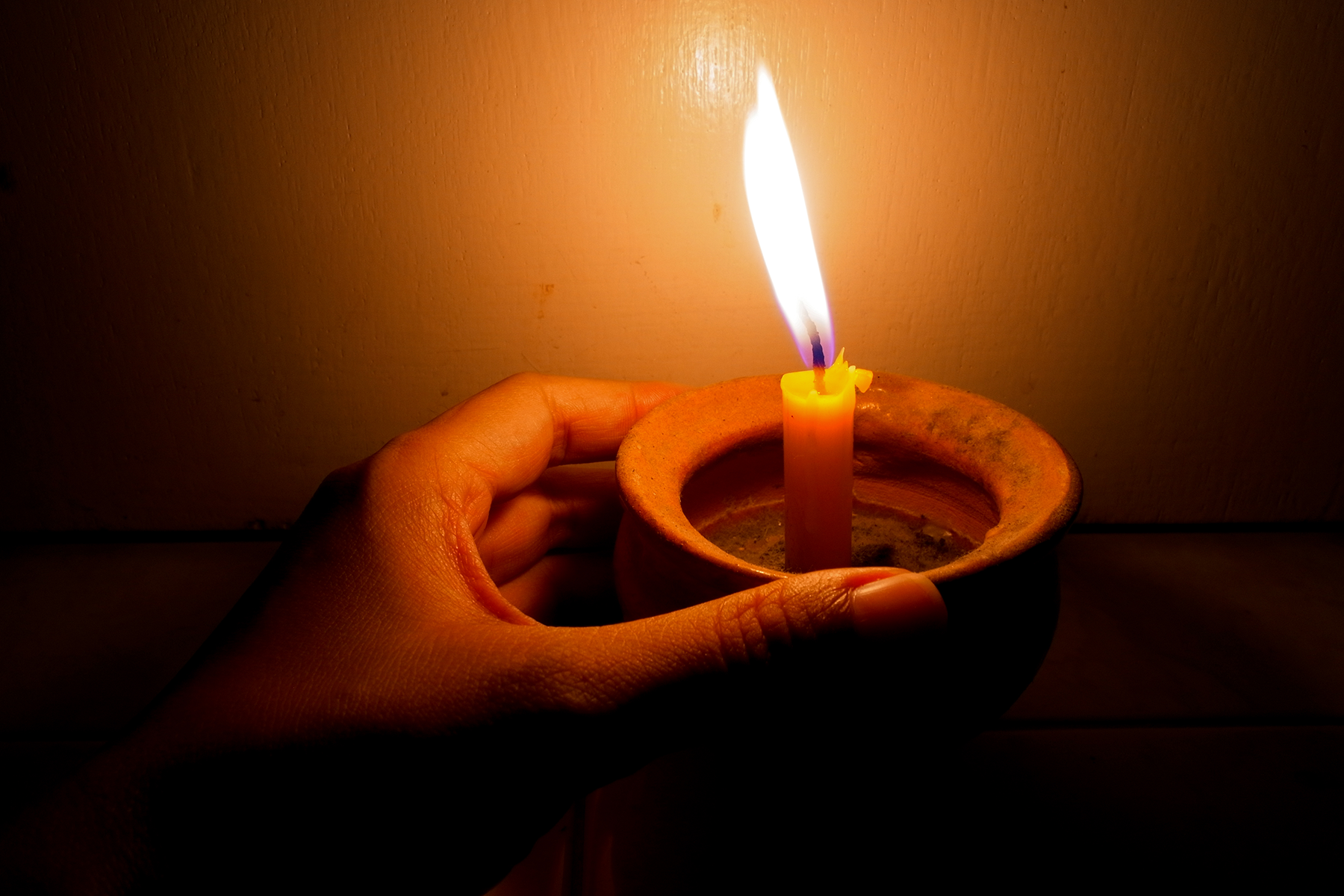
External Gazing: The practitioner sits comfortably, eyes level with the candle flame approximately two to three feet away, and gazes steadily at the flame while minimizing blinking. The practice continues until the eyes naturally begin to water or feel a mild burning sensation. This stage exercises the muscles of the eye, stimulates the optic nerve and brain, and trains focused attention.
Internal Gazing: Once the eyes are closed, the practitioner shifts attention inward, attempting to maintain a vivid mental image of the flame — usually visualized at the ajna chakra, the energetic center between the eyebrows, associated with the “third eye.”
The luminous afterimage left on the retina by the bright flame makes this visualization particularly accessible, even for beginners. When the afterimage fades, the eyes are opened again and the cycle repeats. This two-stage structure is not arbitrary. It mirrors the yogic progression from dharana (fixing attention on an external object) to dhyana (sustaining awareness without external support), following the classical eight-limbed path of Patanjali’s Yoga Sutras.
Tratak and Meditation: The Inner Connection
From a traditional yogic perspective, Tratak is not merely a useful exercise — it is a gateway. The Hatha Yoga Pradipika lists it among the purification practices precisely because it prepares the mind for the subtler limbs of yoga. In practice, Tratak cultivates at least three of Patanjali’s eight limbs simultaneously:
Pratyahara (withdrawal of the senses): By fixing all attention on the flame, every other sensory input recedes. Sounds, peripheral movement, bodily sensations — all fade to the background. This voluntary sensory withdrawal is one of the most difficult skills in meditation, and Tratak trains it naturally.
Dharana (concentration): The sustained, unwavering gaze is, by definition, a training in single-pointed concentration. Every time the mind wanders and returns to the flame, the practitioner is performing the fundamental rep of mental training.
Dhyana (meditation): In the second phase — eyes closed, holding the inner image — the practice naturally transitions into meditation. When the visualization becomes effortless and the boundaries between observer and observed begin to dissolve, Tratak has fulfilled its role as a bridge to deeper states.
For people who find open-eyed or breath-based meditation difficult, Tratak offers a concrete, tangible object of focus. The flame is endlessly interesting — it moves, it flickers, it changes color — while remaining fixed in space. This dynamic stability makes it an ideal anchor for a wandering mind. Regular practitioners often report that their general meditation practice deepens significantly after incorporating Tratak, finding it easier to sustain attention during seated practice and to transition into quieter mental states more quickly.
“...the flame burns, the mind gathers itself, and the endless noise of the day begins to still.”
How to Practice Tratak: A Beginner’s Guide
1. Prepare your space. Choose a quiet, dimly lit or darkened room. Eliminate drafts that would cause the flame to flicker excessively. Remove contact lenses.
2. Position the candle. Place the candle on a stable surface at eye level — you may need to prop it on books. Sit approximately two to three feet (60–90 cm) away.
3. Sit comfortably. Adopt a comfortable, upright seated position — cross-legged on the floor, in a chair, or in any stable meditation posture. Keep the spine erect and the body relaxed.
4. Take a few deep breaths. Allow the body to settle before beginning.
5. Begin gazing (Bahir Tratak). Open your eyes and rest your gaze gently near the base of the flame, just above the wick. Minimize blinking, but do not strain. Allow the gaze to be steady but soft. Beginners should aim for two to three minutes.
6. Transition inward (Antar Tratak). When the eyes begin to water or burn lightly, gently close them. Turn your attention to the space between the eyebrows and attempt to recreate the image of the flame in your mind’s eye. Hold this as long as the image is clear and vivid.
7. Repeat. When the afterimage fades, open the eyes and resume gazing. Repeat the cycle two to three times per session.
8. Close the practice. After the final cycle, keep the eyes closed, relax all effort, and rest in quiet awareness for a few minutes. Rub the palms together and gently cup them over the closed eyes (palming) to soothe and relax the eye muscles.
Duration: Beginners should start with two to five minutes of total practice and increase gradually over weeks. Experienced practitioners may extend sessions to 15–20 minutes. Daily practice is recommended for cumulative benefits.
Tratak occupies a unique position in the yoga tradition — simultaneously practical and profound, accessible to beginners and valued by advanced practitioners, rooted in ancient wisdom and increasingly supported by modern science. In a world characterized by fragmented attention, digital overstimulation, and chronic stress, the invitation to sit quietly with a candle flame for ten minutes feels almost revolutionary.
Whether you approach Tratak as a therapeutic tool, a stepping stone into meditation, or a doorway into the deeper dimensions of yogic practice, the core experience is the same: the flame burns, the mind gathers itself, and the endless noise of the day begins, however briefly, to still.
How to Reset
Join us for this class combining Yoga Nidra, Tratak, Mudras, and Pranayama at Lipé House of Wellness (Coral Gables, FL)
This nourishing weekly practice offers a sacred hour to pause, breathe, and return to your center. Bring a yoga mat, water bottle, and an open mind. All other props provided. Reserve your spot and begin your weekly reset practice. For registration and more information, contact Lipé House of Wellness. Fridays 1:00 - 2:00 PM at Lipé House of Wellness, Coral Gables. Drop-in friendly | Available also through Classpass.
Always consult a qualified yoga teacher before beginning Tratak practice, and a medical professional if you have any pre-existing eye conditions. This article is for informational purposes only and does not constitute medical advice.
